Sunday, June 3, 2018

Weekend Link Love — Edition 506

Research of the Week

Spin classes: good for your fitness, bad for your ears.

Merging academics with physical activity boosts both without sacrificing either.

In older adults, “negative wealth shocks” increase all-cause mortality.

A packed schedule kills productivity.

Keto-related changes to the gut biome mediate the reduction in seizure activity.

New Primal Blueprint Podcasts

Episode 249: Wendy Myers: Host Elle Russ chats with Wendy Myers about the truth behind detox.

Each week, select Mark’s Daily Apple blog posts are prepared as Primal Blueprint Podcasts. Need to catch up on reading, but don’t have the time? Prefer to listen to articles while on the go? Check out the new blog post podcasts below, and subscribe to the Primal Blueprint Podcast here so you never miss an episode.

Interesting Blog Posts

Yes, you can still have bacon.

It’s hard to fathom the psychological toll of long-term space travel.

Media, Schmedia

Bakeries, candy shops receive bomb threats. Sugar cane plantation workers found beheaded. Unilever exec found smothered in canola oil-based margarine. Will nothing stop these keto-paleo zealots?

Pullups are useful.

Everything Else

How mental “deficits” can actually become strengths.

Britain gets CAFOs.

Seattle mussels test positive for opioids.

Things I’m Up to and Interested In

I agree with this list: 13 health experts to help you live better and more creatively.

I’m entirely unsurprised: Turns out that overfeeding butter and coconut oil to the tune of 1000 extra calories is not a good treatment for fatty liver. Go figure.

Concept I’m pondering: Are dreams real? Does the distinction actually matter?

I’m even entirelyer unsurprised: Incentives matter.

I’m skeptical of the distinction made: Cheap bread, expensive bread—it’s all bread.

Recipe Corner

Time Capsule

One year ago (May 27– Jun 2)

Comment of the Week

“Sure, but now you have to carry a copy of that study around with you to show you mean it from a purely scientific perspective.”

– That’s good advice, Joanne.

The post Weekend Link Love — Edition 506 appeared first on Mark's Daily Apple.


from Mark's Daily Apple https://ift.tt/2JpSQ6N

Saturday, June 2, 2018

Steak and Shirataki Noodle Stir-Fry

If you’ve been curious about shirataki noodles but haven’t tried them yet, this recipe is exactly what you need. It shows how easy it is to prepare shirataki noodles and satisfy your cravings for an Asian-inspired noodle dish.

Shirataki noodles don’t have much flavor on their own, but when added to a saucy stir-fry they soak the flavor right up. A favorite way to serve the noodles is tossing them into a beef stir -fry with mushrooms and bok choy. This is an excellent stir-fry without noodles, but it’s fun and tasty to add shirataki every so often.

This stir-fry is delicious hot, but save some for lunch the next day. Shirataki noodle stir-fry is also really good served as a cold noodle salad.

Time in the Kitchen: 35 minutes

Servings: 4

Ingredients

  • 2 packages/14 ounces/400 g shirataki angel hair noodles
  • 1 pound/453 g top sirloin or skirt steak cut into ¼ inch-thick slices (about 3 inches long)
  • 2 tablespoons tamari (30 ml)
  • 1 tablespoon rice wine vinegar (15 ml)
  • 1 tablespoon sesame oil (15 ml)
  • 1 tablespoon coconut aminos (15 ml)
  • 1 teaspoon fish sauce (5 ml)
  • 2-inches/5 cm ginger root, peeled and thinly sliced
  • 2 garlic cloves, thinly sliced
  • 2 tablespoons PRIMAL KITCHEN® Avocado Oil (30 ml)
  • 8 ounces mushrooms, thinly sliced (230 g)
  • 4 heads baby bok choy, thinly sliced

Instructions

Bring a large pot of water to a boil.

Open the packages of shirataki noodles and drain the noodles in a colander. Rinse well under cold water.

Add the noodles to the boiling water. Boil 2 minutes. Drain.

Heat a large skillet (12 inches/30 cm) or a wok over medium-low heat. Do not add any oil. Add the shirataki noodles to the dry skillet and cook for 8 to 10 minutes, using tongs to frequently turn and move the noodles as they cook. This process dries out the noodles. You’ll know they’re dry when they suddenly start to squeak as they’re moved around the skillet. Remove the noodles from the skillet and set aside.

Whisk together tamari, rice wine vinegar, sesame oil, coconut aminos, fish sauce, ginger and garlic.

Pour half of the mixture over the beef. Set aside.

Heat a large skillet (12 inches) or a wok over medium-high heat. Wait several minutes for the pan to get really hot, then add the beef. Cook, stirring just a few times, until meat is cooked, 3 minutes. Transfer the meat to a plate.

Let the pan heat up again and add the avocado oil. Add the mushrooms. Cook until mushrooms are soft, 3 to 5 minutes. Add the bok choy. Cook until just tender, 2 minutes.

Add the noodles and the reserved marinade. Toss the noodles well to coat. Add the beef to the pan and cook just until heated. Serve immediately.

The post Steak and Shirataki Noodle Stir-Fry appeared first on Mark's Daily Apple.


from Mark's Daily Apple https://ift.tt/2sC6byJ

The Diminished Scale

The diminished scale is a symmetrical scale that is built by alternating whole steps and half steps and is used to solo over diminished seventh chords. Dim7 chords are not as commonly used as m7, dominant 7th or maj7 chords in jazz standards, but when they do pop up, they have a tendency to handcuff beginning improvisers. This lesson will introduce you to the diminished scale, which will allow you to confidently and musically solo over Dim7 chords the next time you encounter one in a jazz tune.

This lesson will explain how to build, play, and solo with the diminished scale, as well as provide you with practice patterns, arpeggio patterns, and sample licks to help take your Dim7 soloing phrases to the next level.

 

30 Days to Better Jazz guitar

What Is The Diminished Scale?

The diminished scale is an eight-note scale that is built by picking a tonic note, and then alternating whole steps and half steps from that starting note. Because of that it is also commonly referred to as the whole-half diminished scale.

To help you visualize how the diminished scale is constructed, here is a chart that lays out the interval structure for this scale, as well as showing how the whole (W) and half (H) steps are used to create this octatonic scale.


Diminished Scale 1 9 b3 11 b5 #5 13 7 1
W H W H W H W H


The diminished scale is used to solo over diminished 7 (Dim7) chords.


The diminished scale is different from the dominant diminished scale, which alternates half and whole steps and is used to solo over dominant 7b9 chords.

When first exploring diminished scales on guitar, it is easy to confuse the two scales. To help keep these two scales separate in your head, and on the fretboard, here is a quick way to think of each scale:

  • Dominant 7b9 diminished = half-whole
  • Dim7 diminished = whole-half

Diminished Scale Fingerings

To begin your study of diminished scale fingerings, here is a two-octave shape from the 6th string that stays in position, which means that there is no shifting up or down the neck as you play this scale on the guitar.

This scale is written from the root note G, and so it is called a G diminished scale. Once you can play this fingering, or any fingering in this lesson, in the given key, make sure to move it to other keys.


Listen & Play Along
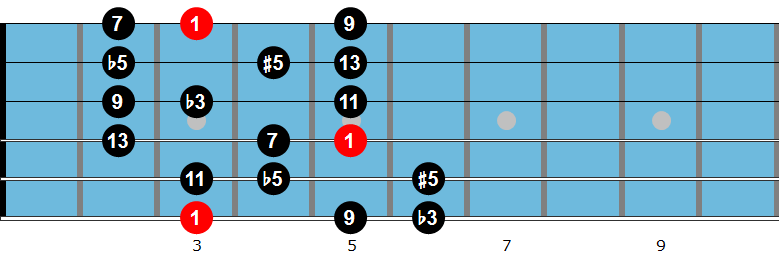
G diminished scale fingering 1


You can also play an in-position G diminished scale from the 5th-string root note, which you can see and hear in the following example.


Listen & Play Along
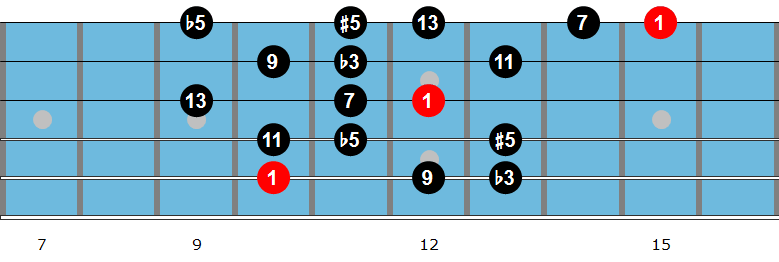
G diminished scale fingering 2


Moving on, here is a G diminished scale from the 6th string that shifts up the neck, which is an effective fingering for moving between positions on the guitar.


Listen & Play Along
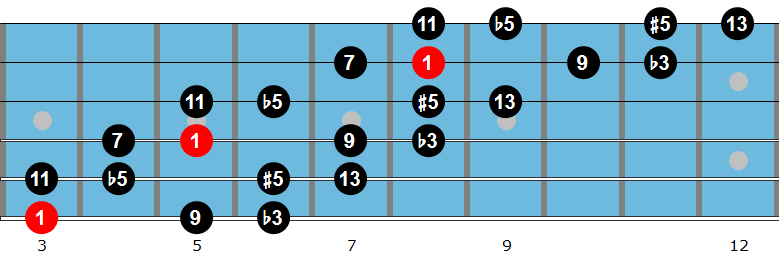
G diminished scale diagram 1


The final fingering in this lesson is a G diminished scale from the 5th string that shifts up the fingerboard.


Listen & Play Along
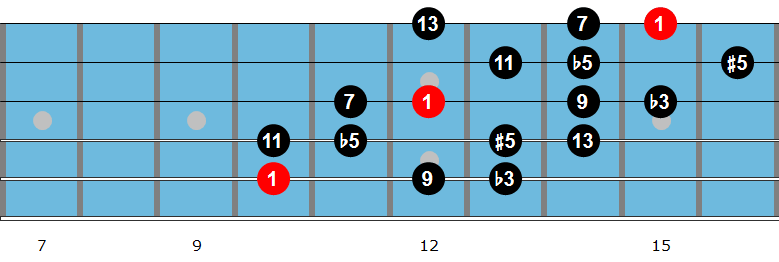
G diminished scale diagram 2


Once you can play one, or all, of these diminished scale fingerings, put on a Dim7 backing track and begin to solo over that chord using the fingerings from this lesson.

As well as learning to play these scales on the guitar, it is also important to take these shapes to the improvisational side of your studies to prepare yourself for applying them to jazz tunes and progressions.

Diminished Scale Practice Patterns

Next, you will learn to play four variations of a common jazz scale pattern called diatonic thirds. Here it is applied to the G diminished scale from the 6th string root. Any of the patterns in this section of the lesson can be applied to any key, and to any fingering, 6th, and 5th string roots.

To begin, here are ascending 3rds through the G diminished scale.


Listen & Play Along
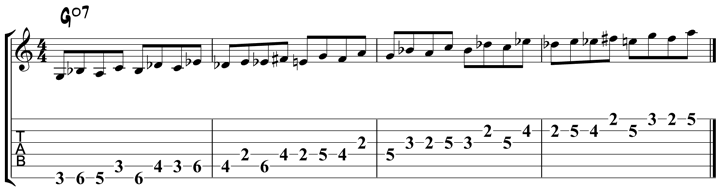
Diminished Scale 5


Moving on, here are descending 3rds played over a G diminished scale.


Listen & Play Along
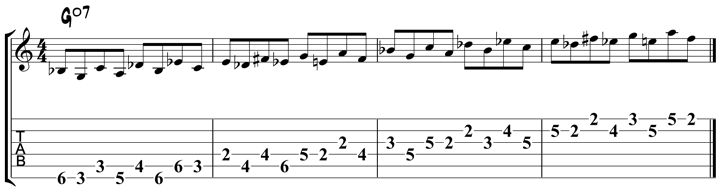
Diminished Scale 6


The next practice pattern variation features the first 3rd ascending followed by the second 3rd descending. This is referred to as alternating 3rds when applied to scale practice.


Listen & Play Along
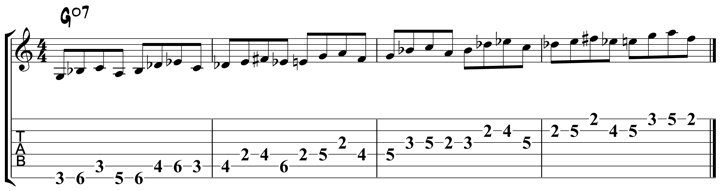
Diminished Scale 7


The final practice pattern is a reversal of the pattern you just learned, only now you are playing the first 3rd descending, followed by the second 3rd ascending.


Listen & Play Along
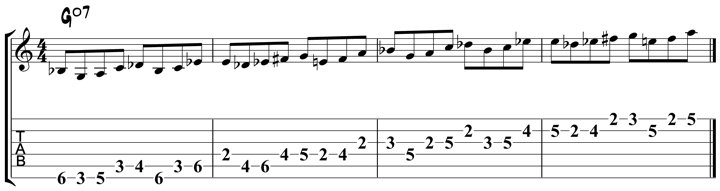
Diminished Scale 8


Diminished Scale Arpeggios

When studying diminished scales, one of the most interesting concepts that you can explore is the use of both Dim7 and dominant 7th arpeggios through this scale.

Because you can solo over Dim7 chords with the diminished scale, it is no surprise that you can use Dim7 arpeggios built from this scale in your soloing lines, but many of us may not yet be aware that you can also use dominant 7th arpeggios from the scale to solo over Dim7 chords.

To understand this concept, let’s break down a C diminished scale by first looking at its notes:


C diminished scale C D Eb F Gb G# A B C


When you build arpeggios from the 1st, 3rd, 5th, and 7th notes of this scale you produce 4 Dim7 arpeggios:

  • Cdim7 = C Eb Gb A
  • Ebdim7 = Eb Gb A C
  • Gbdim7 = Gb A C Eb
  • Adim7 = A C Eb Gb


Now, let’s take a look at the four arpeggios that you build when starting from the 2nd, 4th, 6th and 8th notes of the scale, which are all dominant 7th arpeggios:

  • D7 = D F# (Gb) A C
  • F7 = F A C Eb
  • Ab7 = Ab (G#) C Eb Gb
  • B7 = B D# (Eb) F# (Gb) A


To see these arpeggios on the guitar, here are the ascending versions of each arpeggio in a C diminished scale:


Listen & Play Along
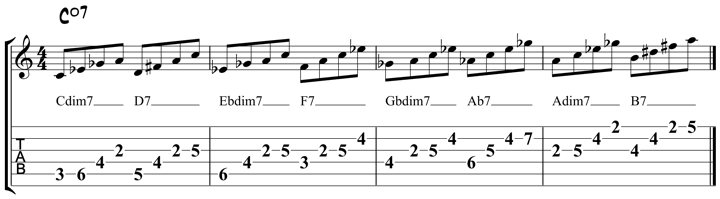
Diminished Scale 9


Here is a G diminished scale from the 6th string with the ascending arpeggios applied to this fingering:


Listen & Play Along
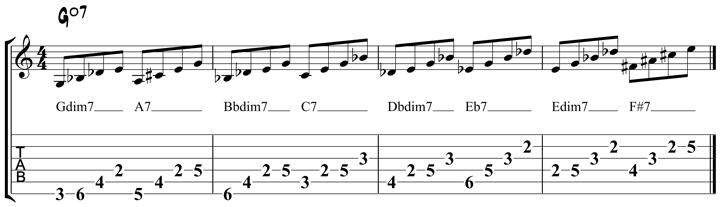
Diminished Scale 10


Diminished Scale Licks

To finish this introduction to the diminished scale, here are three licks that you can study and apply to your playing when soloing over Dim7 chords.

The first lick uses 3rds to solo over a Dim7 chord, in a four-bar phrase.


Listen & Play Along
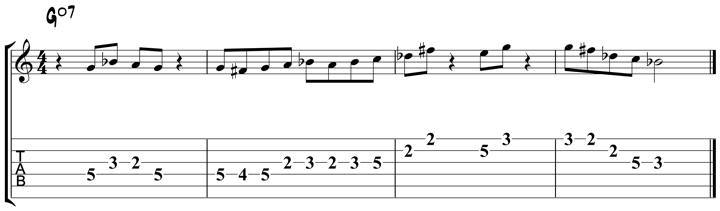
Diminished Scale 11


Moving on, the second lick uses a Bb diminished scale to solo over a Bbdim7 chord in a iiim7-bIIIdim7-iim7-V7 progression.


Listen & Play Along
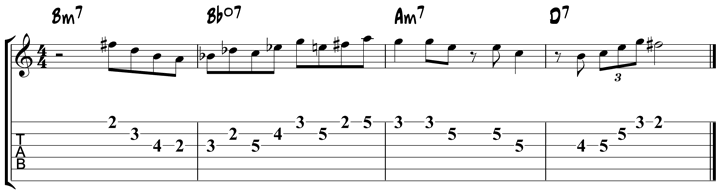
Diminished Scale 12


The final lick in this lesson uses the same Bb diminished scale over a Bbdim7 chord, though in this case, you will draw from the arpeggios in that scale to build your line.


Listen & Play Along
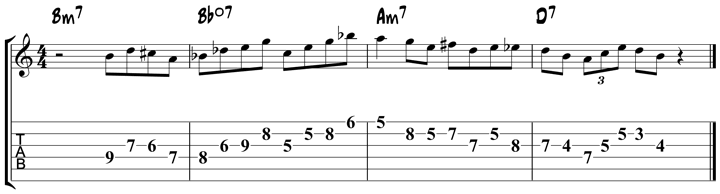
Diminished Scale 13


The diminished scale is often a bit tricky to study on the guitar, compared to the major scale modes which are usually quicker and easier to work out on the fretboard. But, by working out various fingerings and practice patterns, you will ensure that you are ready to nail any Dim7 chord in your soloing lines the next time you run into one.



The Easy Guide to Jazz Guitar 3 eBook Bundle

The post The Diminished Scale appeared first on Jazz Guitar Online | Free Jazz Guitar Lessons, Licks, Tips & Tricks..


from Jazz Guitar Online | Free Jazz Guitar Lessons, Licks, Tips & Tricks. https://ift.tt/2xBq6Dy

Friday, June 1, 2018

Becoming Fat-Adapted Has Been the Key To My Success!

It’s Friday, everyone! And that means another Primal Blueprint Real Life Story from a Mark’s Daily Apple reader. If you have your own success story and would like to share it with me and the Mark’s Daily Apple community please contact me here. I’ll continue to publish these each Friday as long as they keep coming in. Thank you for reading!

At the end of 2013 I was getting ready to begin my last semester of college, but unfortunately I was quickly closing in on 310 pounds at 21-years-old. I knew that I needed to make some changes if I was going to enjoy this life that I was given. So I embarked on a journey to lose weight and I went about it the best way I knew how … Calories in vs. Calories out. I began restricting my caloric intake to ~1,200 calories a day and trying to exercise as much as possible. I would run close to 30 miles/week and try to play basketball or raquetball on top of that to burn the maximum number of calories possible. My diet consisted of relatively low carb, low fat, low sugar blandness that was miserable to eat, but I was determined to lose the weight so I willed myself through it with excuses like “ I lost the genetic lottery, so this is the only way for me to be healthy.” I was successful too, in 5 months I lost over 90 pounds and was leaner than I had ever been in my life. As the months ticked on, I found it harder and harder to maintain the success that I had found.

I began dating my wife long distance in April of 2015, and I was no longer interested in counting calories, watching what I ate, or running 30 miles a week. I just wanted to spend time with her and have fun! Throughout our dating relationship and the first few months of marriage my weigh creeped back up. We were enjoying being young and in love with “frozen dairy treat” (Ice cream), “Hot Now” Krispy Kreme Donuts, and not spending time exercising. Naturally, my weight began to balloon, and before I knew it I was back over 270 lbs. Something had to give. I had worked too hard to lose all the weight to just let it all go, but I didn’t have it in me to cut my caloric intake way back and to run like I did the first time. I was desperate and willing to try anything.

Several friends and family members had done this weird thing called Whole30®, and said that they really felt better and that maybe I should give it a try. I got the book, sat down and read the entire thing in one night. I was fascinated with how the food we eat affects our bodies, minds, and health. On August 8, 2016 (two days after my birthday because I needed that one last binge of ice cream, cake, and beer) my wife and I began our Whole30. The results were stunning! We both lost weight, had more energy and generally felt better than we ever had. This food stuff must really work! Since we had such great success and felt so good we decided to just keep going after the thirty days were up.

I began consuming as much information as I could about the paleo/primal lifestyle which is when I discovered Mark’s Daily Apple. I found that the information Mark provides is accessible and balanced. It has provided me with ideas and concepts that helped me to tweak and adjust my eating strategy and allow me to make the changes I was making sustainable. I breezed through The Primal Blueprint and when The Keto Reset came out I couldn’t wait to get my hands on it. I implemented Primal Blueprint Fitness and have seen dramatic changes in my body composition. My muscles are more defined than ever, and I have been amazed at how easy it has been to build muscle while not killing myself at the gym!

Becoming fat adapted has been the key to my success! I was once dependent on eating constantly to fuel my body, but I implemented intermittent fasting as a daily practice. I typically drink a cup or two of coffee with coconut oil in the morning and then do not eat until four or five in the afternoon. I have found that my energy has increased and my weight loss has quickened.

In January of this year I stepped on the scale for the first time in a few months, I was amazed at what I saw. 197 pounds. My jaw dropped, I stepped off the scale and then back on. 197 pounds it read again. For the first time in over ten years I was under 200 pounds! More importantly, I have more energy, I feel better and I just generally enjoy life more than I ever have before. Thank you, Mark, for providing a resource for people like me to tap into. Thank you for making information accessible and digestible. Thank you for helping me to change my life!

Rob Edens

The post Becoming Fat-Adapted Has Been the Key To My Success! appeared first on Mark's Daily Apple.


from Mark's Daily Apple https://ift.tt/2Hayrh2

Tired of Subpar TV? OWN’s Line Up is #BlackExcellence


By Brenda Alexander

When OWN debuted, I was disappointed. Between the reruns of Dr. Phil and 20/20, I couldn’t figure out what the hell Auntie O was doing. Fast-forward to today and she's developed some of the greatest quality shows and content television has ever seen.

OWN’s seasonal campaign is “See Yourself” and that’s exactly what I’m able to do with her current programming. There’s a little something for everyone. For those who have grown tired of Bravo, WeTV and all things Viacom, look no further than OWN to satisfy your needs of multi-faceted stories that depict us in all forms. Here’s a look into what you’ll find in its current rotation.

Continue

Kofi Siriboe, Rutina Wesley & Dawn-Lyen Gardner
Queen Sugar
Ava DuVernay outdid herself with the level of love and precision she’s poured into this show. Adapted from the novel of the same title, Queen Sugar follows the Bordelon family as they run an ailing sugar cane farm their patriarch left behind. The show exposes the hardships of black farming in the deep south of Louisiana paralleled to its white privileged counterparts and the depths a family will go to keep their land theirs while preserving the family. Kofi Siriboe brings vulnerability to Ralph Angel, a young single father with a checkered past trying to do right, while a record tails his every move. Aunt Vi, played by Tina Lifford, shows a different side of a black matriarch: wise, sexy and powerful with a younger chocolate and suave beau, Hollywood (Omar Dorsey). Charley (Dawn-Lyen Gardner), the single mom and businesswoman, takes lead of the farm post cheating scandal from her NBA player ex-husband, forcing she and her teenaged son to flee LA. Her son Micah (Nicholas L. Ashe) is stuck between his posh past and desire to be more pro black. Rutina Wesley is unmatched as Nova in her acting both physical and emotive: a nose ring wearing, hair locked, sage burning activist free in her speech and sexuality, unapologetically. This season, Charley and RA embark on a secret partnership with a rival white owned farm. RA is reeling from the discovery that his beloved son Blue may not be biologically his. Charley continues to make business decisions based on merit versus moral and Aunt Vi and Hollywood plan a wedding while keeping the family unit tight. Wednesdays at 10 are a little sweeter thanks to Queen Sugar.

Black Love Couples 
Black Love
For as much dysfunction as we see on Love & Hip Hop and the likes portraying black marriages, Black Love is a refreshing docu-series showcasing the stories of some of our favorite celebrity couples and everyday people telling their stories of courtship, dating and finally the walk down the aisle. Each episode has a different theme and explores different areas of relationships and how they survived along the way. Newlyweds and couples married 60+ years share their insight into what makes a successful and happy marriage. Directed by filmmakers Codie Elaine Oliver and Tommy Oliver, the married couple makes their living from interviewing other married couples as a way to gain knowledge on marriage sustainability and a way to expose black love to the world. Grab your bae and some tissues and tune in every Saturday at 10.

Michele Weaver & Will Catlett
Love Is...
Salim and Mara Akil married in 1998 and have been a force to be reckoned with in film and television with shows like Girlfriends, The Game and Being Mary Jane. Most couples who work together don’t last but these two are keeping love alive, both personally and professionally. The Akils are bringing the story of how they came to be a couple to OWN in Love Is. Set primarily in 90’s LA, against a Black Hollywood black drop, it follows Nuri (Michele Weaver) and Yasir (Will Catlett) as they chase their dreams and each other. The show will also revisit the social issues and vibrant black culture of that time and its parallel to how it shaped them 20 years later. Love Is will premiere on June 19.

(left to right) Merle Dandridge, Oprah Winfrey, Lynn Whitfield & Keith David
Greenleaf
The Greenleafs are a semi-corrupt, semi-good Christian Church-owning southern family with secrets that every Black church has seen. Led by Lynn Whitfield as Lady Di, First Lady of Calvary has enough hats and attitude to match. She and her husband Bishop, run a tight ship while the family reels through a painful family omen: their middle daughter Faith commits suicide in the first season after struggling years post sexual abuse from Uncle Mac, Lady Di’s brother and the Church’s deacon. Grace returns after years of absence from the family and church to bring Mac down, much to Lady Di’s dismay. Jacob, the only son, is a recovering adulterer with a wife who wants power and pushes Jacob to start a rivalry Church, Triumph, after Bishop turns down his pleads to preach and instead gives the pulpit to the more talented Grace. The baby sister Charity is mama’s favorite who discovers her husband is gay while pregnant with twins. Going into Season 3, Uncle Mac ends up dead, extramarital affairs between the Bishop and Lady Di are revealed and the Greenleaf grandkids are sexing it up and in abusive relationships while Church is still in session. If you want to partake in such sin, tune in this August for Greenleaf’s resurrection.

Of course, there’s much more that OWN has to offer. Sweetie Pies is in its final season and Tyler Perry is leading the ratings with the dramatic The Have and the Have Nots. OWN is a network to enjoy and when it’s inspirational interviews featuring Motha O return to Super Soul Sundays, the best is yet to come!

Do you have a favorite OWN network show? 
Brenda is a Philadelphia native with a love for Marketing, Creative writing, wine and Jesus. Her work has been featured on Mayvenn’s Real Beautiful blog and she is the co-author of the book Christmas 364: Be Merry and Bright Beyond Christmas Night (available for purchase on amazon). Follow her on IG @trulybrenda_ and trulybrenda.wordpress.com


from Natural Hair Care | Curly Nikki https://ift.tt/2HckBdU

Have You Been Gaslighted During Sex? Chances Are You Have.

The Truth About Domestic Violence From Family Left Behind

Antoinette White and her niece
By Erickka Sy Savané

3 or more women are murdered by their boyfriends or husbands every single day in the United States. It's the type of tragedy you pray never happens in your family, and then it does. Antoinette White knows this story all too well because her younger sister Heather was brutally killed by her boyfriend who was also the father of her child (1 years old at the time), and a surrogate dad to her special needs son (age 3). For those who are left behind, life changes instantly. Here's how Antoinette's family were able to pick up the pieces.

Continue
Antoinette w/Heather's kids
Hi Antoinette, first tell me, how was it decided who would take care of the children?
When my sister died I felt it was unfair that my mom would have to raise children all over again. My brother was graduating from high school and it was now time for her to live her life. However, she was adamant, saying that she was grieving the loss of her daughter and her grandchildren were the closest thing she had to her. Unfortunately, my niece’s paternal grandfather wanted custody too. He was trying to split the kids up and only wanted my niece because she was biologically his. So not only were we grieving the death of my sister, now we had a custody battle with the father of the man who killed her.

How did you deal with that?
We couldn’t believe it. Fortunately, the daycare that my niece attended found out about what was happening and one of the moms was a lawyer and took the case pro bono. So she represented my mom and hammered him. We found out that he had found a 24-hr daycare center that he was going to put her in because he only wanted the money. We didn’t even know daycares like that existed. It was a very difficult time, but my mom eventually got custody.

The home Antoinette and her family lived in
How did it work out with your mom having custody?
She got some help because her twin sister quit her job so she could help. I got my niece and nephew in the summer to give my mom a break. It was a lot because the kids (my two and my sister’s two) were all around the same age, plus my nephew was special needs, and required more care. As my mom began to get older I saw how her job was affecting her and she was tired. So after much convincing, she let me help, and moved to Virginia with me and my two, so I could help raise them. It was taxing, but when you’re in the midst you don’t really see it that way. You do what you have to do for family. I bought a house that I couldn’t afford, but, God made a way. Sometimes I would use some of my school loan refund to help make ends meet.

How is the relationship between your side of the family and your niece’s father's side?
It was a very difficult time because we had our anger and bitterness about the custody battle, but there was also anger towards their family for not getting my niece’s father counseling. As I mentioned in the previous article, he witnessed his mom getting killed by her boyfriend when he was a young boy, so this is something that he’d seen first-hand. Why didn’t they get him help?

It wasn’t easy, but in the end we chose forgiveness. My niece’s grandmother wanted to be in her life and we know that my sister Heather would have wanted that for her. Today, they have a great relationship. We’re on good terms. I'm also friends with my niece's aunt.

Speaking of getting help, did the children or anyone in your family receive counseling?
Yes, with my nephew we realized that even though he’s special needs, and was only 3 years old when the murder happened, it still had an impact on him. Once, when he was very young and taking a bath with my niece, he pointed a toy gun to her head and said, ‘POW.’ Then put the gun to his head, and did it again. We knew in that moment that he saw what happened and would need counseling. They both went to counseling when they were young, and should have gone back when they were teenagers because now they were dealing with a different set of emotions.

Antoinette and Quinn
How are they doing today?
The are doing fine. My 24-year-old nephew (Marquise) is adjusting to his life as a young special needs adult. My 22-year-old niece (Quinn) is still trying to discover herself and what career she actually wants. The deaths still affect her emotionally, and she struggles with the fact that her father killed her mother. She has a void in her life that we couldn’t fill, though we all came together to help raise her. She struggles with how she would have turned out and the morals her mom would have instilled in her if she was alive.

What advice would you give a family who is reeling from a tragic domestic violence situation like this?
The first thing I would say is be sure to get counseling for yourself and the kids or go to a support group. The support group will help the kids see they’re not alone and help with communicating their feelings. Embrace the different set of grieving emotions you will feel. Heal yourself because you don’t want the remnants of your bitterness to be taken out on the children. Do not put your life completely on hold. Continue doing the things you like to do, keep the kids active in community events and sports and surround them with positive people. Know that it’s okay to feel like you need a break or reach out for help. Finally, don’t blame yourself. It’s not your fault, and forgive. The children grew up in a Christian upbringing and were taught to love their father despite what he did, they were taught to forgive.

Heather & Antoinette as teens 
What advice would you give a person who is in a domestic violence situation?
I’d say there’s only two ways out of the situation. You’re either going to end up dead or in prison for killing him. And no matter whether you stay in the toxic relationship or not, the children are going to be affected. So reach out for help. Call the domestic violence hotline so they can help you plan a safe escape because the majority of domestic violence murders, just like my sister, happen when a victim is trying to leave. The number is 1-800-799-SAFE (7233) or visit the website.

Antoinette White is an author and a motivational speaker. Visit AntoinetteWhite.com for more information.

Do you know a family impacted by domestic violence?
Erickka Sy Savané is managing editor of CurlyNikki.com, a wife and mom, based in Jersey, City. Her work has appeared in Essence.com, Ebony.com, Madamenoire.com and more. When she’s not writing...wait, she’s always writing! Follow her on Twitter and Instagram or ErickkaSySavane.com


from Natural Hair Care | Curly Nikki https://ift.tt/2svUQ3a